President outlines sweeping investments in AI, chips while bolstering military capabilities to accelerate transfer of wartime OPCON from US
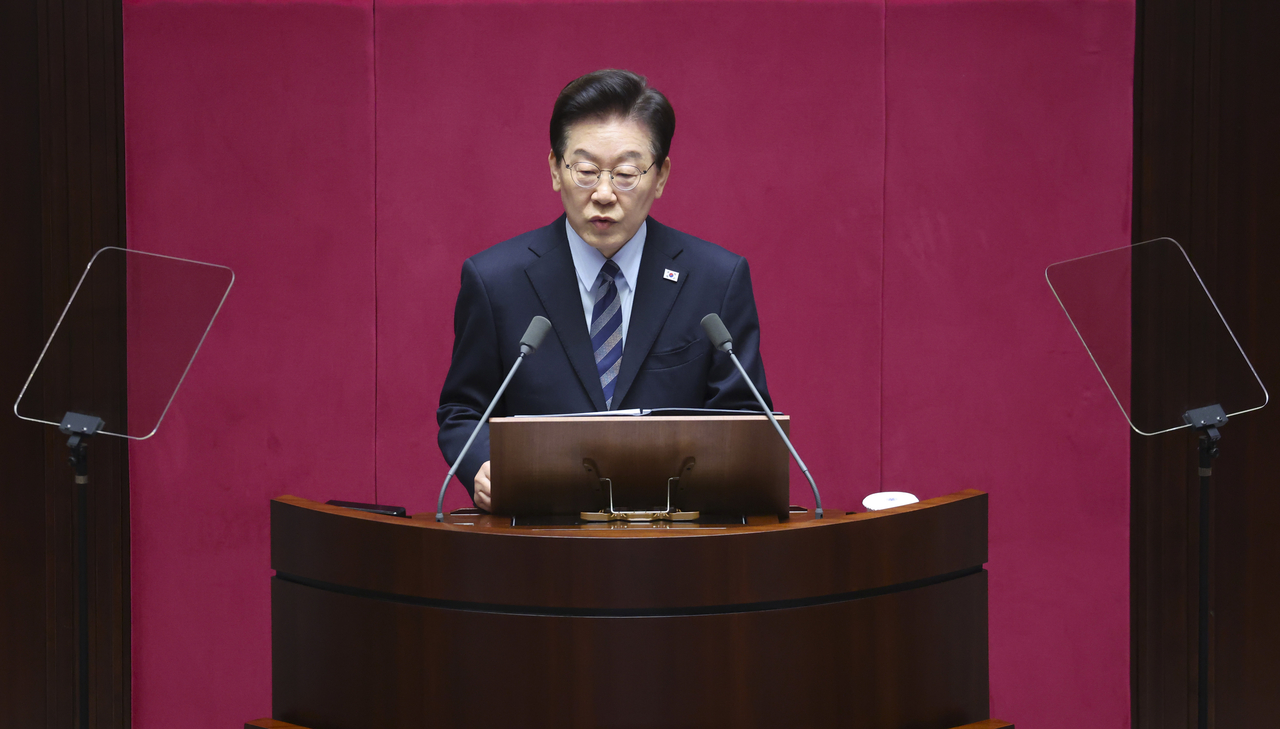
President Lee Jae Myung on Monday laid out a record budget to spur economic growth and narrow inequality under his “growth for all” agenda, while projecting a 20-year low in the managed fiscal deficit.
In his budget speech to the National Assembly, Lee outlined an 820.9 trillion won ($610 billion) spending plan for 2027, up 12.8 percent from this year, the fastest annual increase and largest fiscal outlay in South Korea’s history.
“We have expanded the budget to raise both the standard of living our people deserve and the Republic of Korea’s capabilities for the future, in keeping with our economic achievements,” Lee said, referring to South Korea by its official name.
The proposal prioritizes three flagship megaprojects — semiconductors, artificial intelligence data centers and physical AI — alongside an 8.2 percent increase in defense spending to strengthen military capabilities, including nuclear-powered submarines.
“The 2027 budget is a forward-looking investment plan aimed at making the Republic of Korea an irreplaceable global leader, as well as a ‘growth-sharing budget’ designed to translate national economic growth into gains for its people,” Lee said.
The strategy seeks to overcome what Lee called “K-shaped growth,” in which economic gains are concentrated among certain industries, companies and regions while others fall behind.
“We must move beyond the outdated debate of growth versus redistribution and present a new growth formula suited to changing times and circumstances,” Lee said.
He emphasized the importance of the proposed Future Response Fund as “a strategic investment platform to support a rebound in potential growth and an innovative fiscal-stabilization mechanism to address growing volatility in tax revenue.”
The 162.3 trillion won Future Response Fund would allocate 45.4 trillion won next year to youth programs, growth industries, regional development, and education and talent development. The remainder would help reduce new government bond issuance and build reserves against future revenue shortfalls.
Despite the unprecedented spending increase, Lee insisted that “the underlying strength of our public finances will also become even stronger.”
The Lee administration projects the managed fiscal deficit will narrow to 0.1 percent of gross domestic product in 2027 from 3.9 percent this year, its smallest shortfall in two decades. The national debt-to-GDP ratio is forecast to fall to 48.3 percent from 51.6 percent.
The fiscal outlook hinges partly on a semiconductor-driven surge in tax receipts. The government forecasts total revenue will jump 30.4 percent to 880.8 trillion won next year, far outpacing the planned increase in spending.
“Although we will issue government bonds, most of the proceeds will be used to repay existing debt, leaving almost no net increase in outstanding debt from new bond issuance,” Lee said.
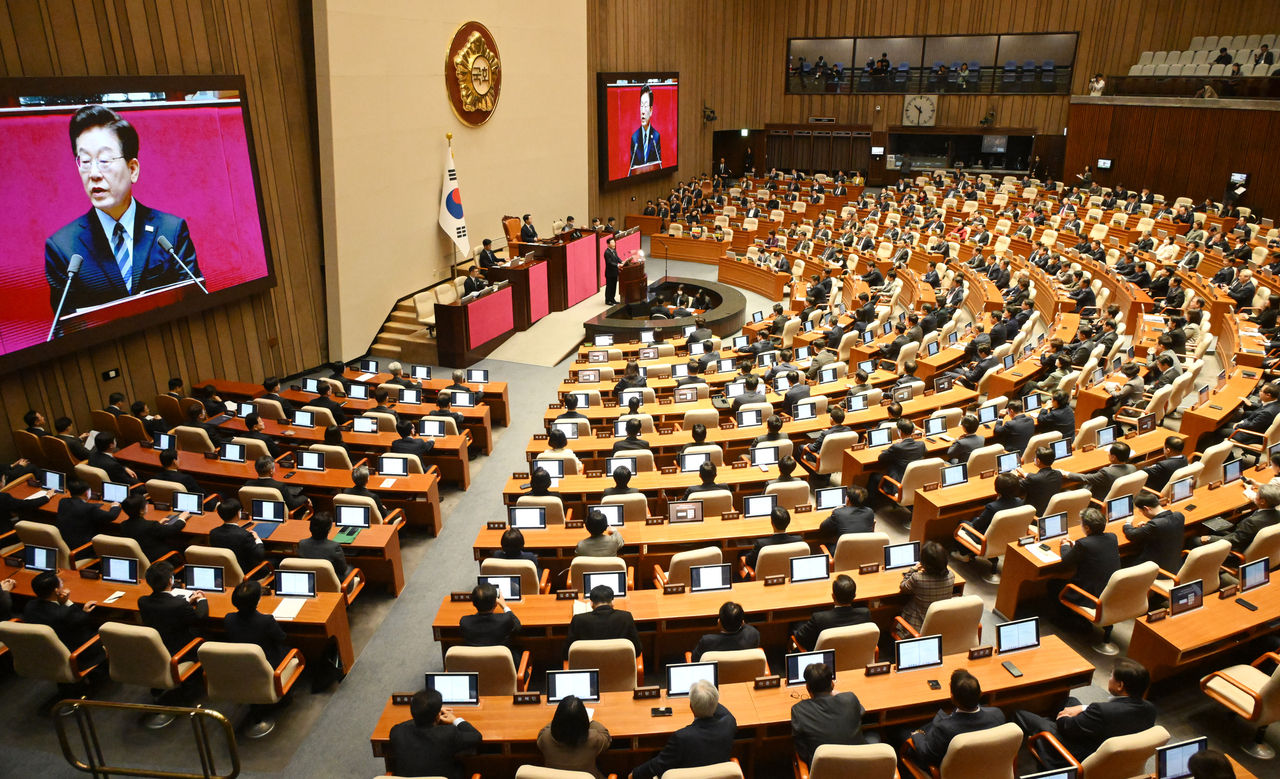
The remarks drew protests from opposition People Power Party lawmakers, some shouting, “That makes no sense.”
As interruptions continued, Lee paused and responded, “You keep interrupting me while I’m speaking. I would appreciate it if you had specific points to raise. May I continue now?”
Bold spending, sweeping fiscal reforms
In his speech, Lee outlined three principles underpinning the budget: invest boldly, but efficiently; prioritize direct fiscal spending over tax expenditures; and give provincial areas preferential treatment to achieve balanced national development.
Lee underlined that the government carried out “a sweeping restructuring of government spending,” covering 107.2 trillion won across 6,476 programs. This included eliminating more than 2,100 existing projects.
Technology investment is central to the spending plan, with the administration nearly doubling allocations for AI and its three flagship megaprojects to 21.3 trillion won.
“We will invest boldly in artificial intelligence and future growth engines to raise the growth potential that forms the foundation of our economy," Lee said.
The proposal earmarks 2 trillion won to expand semiconductor production capacity, including accelerating chip-fabrication plants near Seoul and developing a southwestern industrial cluster.
Another 4.7 trillion won will support frontier AI development, aimed at producing homegrown models capable of competing with leading global systems. The government also allocated 500 billion won for physical AI trials in manufacturing, defense and other sectors, alongside 2.1 trillion won for power, water and industrial infrastructure.
Defense spending will rise 8.2 percent to 73.3 trillion won as Lee seeks greater military self-reliance and an early transfer of wartime operational control from the US.
“To ensure a firm independent defense posture, we will secure powerful core military capabilities, including those needed for an early transfer of wartime operational control, nuclear-powered submarines and the KF-21,” Lee said. “We will build integrated manned and unmanned systems based on AI, robots and drones and rapidly transform into a smart, elite military.”
Beyond technology and defense, Lee pledged expanded welfare support, with youth-related spending jumping 53.5 percent to 43.3 trillion won.
The plan includes marriage grants of 1 million won, childbirth payments of up to 20 million won and expanded child allowances. Eligible recipients would also automatically receive certain welfare benefits without having to apply.
Regional development will receive 33 trillion won, more than double this year’s allocation, as the government seeks to reduce economic concentration around Seoul.
The plan includes relocating 44 central government agencies to Sejong and offering subsidies covering up to half of qualifying corporate facility investments outside the capital region.
The proposal faces parliamentary scrutiny over its spending priorities and fiscal assumptions. Lee urged lawmakers to approve the budget by the Dec. 2 statutory deadline.
“The key is execution and speed,” Lee said. "Now is the time for the government and the National Assembly, across the political aisle, to unite for the future of our country and the lives of our people."
dagyumji@heraldcorp.com